Friday, March 23, 2018

Export Trade Fiance - Packing Finance(Under L/C)

Export Trade Finacing is basically for the sellers/exportors to finance for themselves. There are quite a lot of ways for them to get money from banks, for example packing fiance/Loan, Negotiation under documentary credit, Discount, Forfeiting, Confirmed L/C,  Factoring  etc. Among them , Packing Finance/Loan , Silent Confirmation, Forfeiting and several others occurs when both parties' dealing based on L/C.


Basis

Packing Loan: Exportors(choosing L/C as the way of transaction settlement) can apply for a certain amount of financing before their cargo loading upto the ship to export(Packing stage). Exportors just need to submit the L/C they received from buyer side's bank to the bank they plan to apply the loan from as a collateral to get the money.

Packing Loan initially  is invented to solve the  fiancing need for exportors in their packing stage. But nowadays, most of banks don't follow this. whatever reasons like : goods replenish, goods processing and other steps before the shippment of the goods . you all can appy for packing loan as long as your L/C is real!

Some Banks will need the L/C as a collateral to give the loan out. some just need to check the exportor's credit . but in Aisa, most of banks still need the L/C as a colateral.


Characteristic

  1. Exportor can only use this money to designated items. they can't use it to other investment e.g fix asset investment etc.
  2. Bank will keep the original L/C  as collateral to make sure the applier/Exporter do the presentation of documents in this bank so as to monitor all the way how's the L/C's status. 
  3. Packing loan's time is short. <= 36 days.
  4. With recourse. If exportor can't get the money from importor, bank have the right to deduct principal + interest from the exportor's other account directly

Documents Needed


  1. Company basic liscences and certificates . e.g: tax register liscense. business entity information...
  2. Fill the application form that bank provides
  3. Provide the company financial health evidence e.g Audited P/L, Balance sheet...
  4. Original L/C and contracts
  5. Deposit
  6. Others

Interest Calculation

Loan Amount: 


The Amount Exportor can get(Loan Amount)  = L/C Amount * Margin  

The Margin is set by the bank internally.normally the higher the credit of the exportor , the higher the margin will be . normally the margin is between 70%~90%,if A L/C is 1M , then normally the company can get 700K ~90K loan amount.

Annual Interest Rate:

Annual Interest rate is calculated based on different currencies .If Loan is USD, then use USD loan interest rate , if Loan is YEN, then use Yen loan  interest rate.The interest rate is synced with the central bank. Normally , The bank will choose the latest loan expiry date to let the exportor pay back the principal and interest rate together.

Foreign Currency Financing normally is based on the Inter-Bank Offer Rate (e.g: USD : Libor, YEN: Tibor) + Margin. For exmaple, For USD, Normally the interest rate = Libor + 0.5%~1.5%.For some companies with good credit/reputation, The bank also can only charge Libor + 0.25% as the interest.

Take the data from 28th April 2006 as a example, 12 month Libor is 5.28%, So the bank can choose the interest rate between 5.53% (5.28% + 0.25%)  ~ 6.78% (5.28% + 1.50%) to charge the exportor.

Of course , there're still some banks taking the approach of  20th century, No matter how long the loan they give, alwayse use 1 year walking capital interest rate to charge even though some are less than 1 year. For Example, 2006 April, 1 year foreign currency walking capital loan rate is 6.75%, then the annual interest rate the bank charge the exportor apply for the packing loan is 6.75% as well.

Libor : Currently is regaded as a basis rate of  floating rate(USD), It is regarded as a financing cost of  ( borrow money and re-lend out). The 3 month and 6 Month Libor are most universally used.

Packing Loan giving days:

Packing Loan giving days  = the day to apply for packing loan ~ the latest shipment date stipulated in L/C + 30 Days

For Example , The L/C beneficiary(Exportor) apply for a packing loan on 10/11/2013, The Lastest shipment date in L/C is 31/12/2013. So The Packing Loan giving days are  (10/11 ~ 31/12)  +30 days = 81days. That is between 10/11/2013  ~ 31/01/2004. Normally It is less than 1 year. So The bank will give the money to the exportor gradually within this period.


For Companies to consider


  1. Company should maintain a good credit and no bad records in the bank.
  2. make sure the issuing bank's country economy stability and no political risk, so the payment can be done successfully.
  3. Read the L/C clause carefully.The more complex the clause , the harder the beneficiary to follow.
  4. Make sure the L/C is irrevocable L/C as the bank only can give packing loan based on this.
  5. Choose the correct currency to save the cost.
Exportor can choose domestic currency or froeign currency from bank. company may need to consider the national foreign currency control policy. In Recent years, In China , The foreign Currency loan interest rate is lower than the RMB loan interest rate. So companies may consider to choose foreign currency as loan currency . when using RMB, they will convert the foreign currency into RMB to save the cost.


For example, If exportor need 1M RMB to buy raw material and apply for the packing loan.the company can choose foreign currency packing loand or RMB packing loan. In 2004, RMB loan interest rate is 4.65% and USD loan interest rate 2.98%. Exchange rate at that time is USD100 = CNY826.46 .If choose foreign currency packing loan for 90 days, the interest exportor need to pay :

$ 1M * 2.98% * 90/360 = $ 7649
$ 7649 = 61.7 K (RMB)

If choose RMB packing loan , company need to pay interest:

$ 1M * 8.264 * 4.65% * 90/360 = 96.1K (RMB)

So ,Choose USD packing loan is better.

For Banks to consider


  1. Understand application company's credit and capital situation 
  2. verify the L/C(By SWIFT)
  3. Understand Issuing Bank's credit and rate(Moody's Finth Rating).
  4. verify the clause of L/C
  5. Control the date of giving loan
  6. make sure the Risk Index and credit limit
Credit Limit(trade finance) = walking capital loan amount *   (1 / risk index)
For example:
    If bank of china gives the company A 1M USD loan limit, then A can transfer this 1M loan limit into guarantee limit:
    
guarantee limit  = 1M USD * (1/0.25) = 4M USD

Any Question About this Product Can leave your comments below.


Saturday, September 23, 2017

《爱 》- 张爱玲

      这是真的。 
      这个村庄的小康之家的女孩子,生的美,有许多人来做媒,但都没有说成。那你她不过十五六岁吧,是春天的晚上,她立在门后,手扶着桃树。她记得她穿着一件月白色的衫子,对门住的年轻人,同她见过面,可是从来没有打过招呼的。他走了过来,离的不远,站定了,轻轻说了一声:“噢,你也在这里吗。”她没有说什么,他也没有再说什么,站了一会,各自走开了。 
     就这样就完了。 
    后来这女人被亲眷拐了,卖到他乡外县去作妾,又几次三番被转卖,经过无数的惊险的风波,老了的时候她还记得从前的那一回事,常常说起,在那春天的晚上,在后门口的桃树下,那年轻人。
      于千万人之中遇到你所要遇到的人,于千万年之中,时间的无涯的荒野中,没有早一步,也没有晚一步,刚巧赶上了,那也没有别的话好说,唯有轻轻的问一声:“噢,你也在这里吗?”

Tuesday, September 19, 2017

Java 8 - Parallel data processing

In Java 7 , If you want to process data in parallel, you may consider the ForkJoinPool which is one of the threadpool factory with number of initial thread equalising the number of procesor of the computer :


Runtime.getRuntime().available-Processors() // show initial number of thread

System.setProperty("java.util.concurrent.ForkJoinPool.common.parallelism","12"); // change the number of initial thread


In current multi-core PC world, parallel processing will  mostly increase the performence. And the way to implement the parallelism is as simple as just adding one methond parallel()  into the normal Stream. This parallel() will automaticly make use of the ForkJoinPool behind and dynamicly assign the data into threads.


public static long parallelSum(long n) {
     return Stream.iterate(1L, i -> i + 1).limit(n).parallel().reduce(0L, Long::sum);
}

On the contrary , if you want to abandon parallel(), a sequential() will help you switch back smoothly. Well , In practice, whether to choose sequential() , parallel() or normal for loop , all depend on practical measurement, There is no one golden rule saying that parallel() is the best, you must measure the time and choose which one to apply.


long start = System.nanoTime();
// apply batch calculation here
long duration = (System.nanoTime() - start) / 1_000_000;

In most of the cases , the efficiency lost in the parallel processing is due to autobox problems,  one of the methods to increse the paralle() is to avoid the autobox using LongStream, IntStream... This is important!


public static long parallelRangedSum(long n) {
    return LongStream.rangeClosed(1, n).parallel().reduce(0L, Long::sum);
}

ForkJoinPool

Above, I have mentioned the ForkJoinPool in Java 7 and the parallel() in Java 8 is implemented by it . So how do people use this ForkJoinPool? Answer :  extends RecursiveTask<T>
public class ForkJoinSumCalculator extends RecursiveTask<Long> {
       // constructors and fields .... 
@Override protected Long compute() { // rewrite abstract method if (length <= 1000) { // Don't use parallel } ForkJoinSumCalculator leftTask = new ForkJoinSumCalculator(20000, 1, 10000); leftTask.fork(); // start left half tasks asyncronously in another ForkJoinPool ForkJoinSumCalculator rightTask = new ForkJoinSumCalculator(20000, 10001, 20000); Long rightResult = rightTask.compute(); // start the right half tasks Long leftResult = leftTask.join(); // read the left half tasks result. blocking return leftResult + rightResult; // combine } }

Parallel() is not only implemented by ForkJoinPool but also with the help of Spliterator. With these 2 weapons, parallel() in Java 8 can flexibly split big task ,compute and join together to return values.

Spliterator

Spliterator looks similar to iterator in versions before Java 8. It also helps to iterate data but in parallel way.


public interface Spliterator<T> {
   boolean tryAdvance(Consumer<? super T> action); // iterate all elements Consumer provides
   Spliterator<T> trySplit(); // split data into another Spliterator
   long estimateSize(); // return the size of collection
   int characteristics();
}

Ok, I am still working to produce an example , I will give it out later.

Sunday, September 17, 2017

Java 8 - Data collection


Data collection is simplified in Java 8 syntax very much. you only need to point out "the expected result " not to worry about how to collect. In Java 8 , there exist a factory class "Collectors", let't see how it applies.

Math Problems 


long howManyDishes = menu.stream().collect(Collectors.counting()); // ==
long howManyDishes2 = menu.stream().count();
  
Comparator<Dish> dishCaloriesComparator = Comparator.comparingInt(Dish::getCalories); 
Optional<Dish> mostCalorieDish = menu.stream()
      .collect(Collectors.maxBy(dishCaloriesComparator)); // get object with max calories
  
// get the total calories
int totalCalories = menu.stream().collect(Collectors.summingInt(Dish::getCalories));
  
// get the average calories
double avgCalories = menu.stream().collect(Collectors.averagingInt(Dish::getCalories));
  
// get total, average, max, min 
IntSummaryStatistics menuStatistics = menu.stream().collect(
                               Collectors.summarizingInt(Dish::getCalories));

String Concatenation


String shortMenu = menu.stream().map(Dish::getName).collect(Collectors.joining(", "));

Reduce


// get total calories in reduing way
int totalCalories2 = menu.stream().collect(Collectors.reducing(0, Dish::getCalories,
                                           (i, j) -> i + j));
  
// get the max calories
Optional<Dish> mostCalorieDish2 = menu.stream().collect(Collectors.reducing(                        (d1, d2) -> d1.getCalories() > d2.getCalories() ? d1 : d2));
  
// self-implement toList collector
Stream<Integer> stream = Arrays.asList(1, 2, 3, 4, 5, 6).stream();
List<Integer> numbers = stream.reduce(new ArrayList<Integer>(), // init value
  (List<Integer> l, Integer e) -> { l.add(e);return l; }, // process
  (List<Integer> l1, List<Integer> l2) -> {
                               l1.addAll(l2);return l1; }); // final process
  
// total calories
int totalCalories3 = menu.stream().collect(Collectors.reducing(0,Dish::getCalories,
                                                                 Integer::sum));
int totalCalories4 = menu.stream().mapToInt(Dish::getCalories).sum(); // old way

Group By

Group by is like SQL group by statement., you can do nexted grouping , criteria grouping ...


// group by type , type is an enum
Map<Dish.Type, List<Dish>> dishesByType = menu.stream().collect(
                                          Collectors.groupingBy(Dish::getType));
  
// criteria grouping
Map<CaloricLevel, List<Dish>> dishesByCaloricLevel = menu.stream().collect(
  Collectors.groupingBy(dish -> {
   if (dish.getCalories() <= 400)  {
    return CaloricLevel.DIET; 
   } else if (dish.getCalories() <= 700) {
    return CaloricLevel.NORMAL;   
   }else {
    return CaloricLevel.FAT;
   }}));
// nested grouping
Map<Dish.Type, Map<CaloricLevel, List<Dish>>> dishesByTypeCaloricLevel = 
          menu.stream().collect(
   Collectors.groupingBy(Dish::getType, // 1st grouping
    Collectors.groupingBy(dish -> { // 2ed grouping
     if (dish.getCalories() <= 400) 
      return CaloricLevel.DIET;
     else if (dish.getCalories() <= 700) 
      return CaloricLevel.NORMAL;
     else 
      return CaloricLevel.FAT;
     })));
  
// collecting data with grouping
// result is : {MEAT=3, FISH=2, OTHER=4}
Map<Dish.Type, Long> typesCount = menu.stream().collect(
                  Collectors.groupingBy(Dish::getType, Collectors.counting()));
  
// get the max calories of each group , group by type
//result is : {FISH=Optional[salmon], OTHER=Optional[pizza], MEAT=Optional[pork]}
Map<Dish.Type, Optional<Dish>> mostCaloricByType = menu.stream().collect(
                  Collectors.groupingBy(Dish::getType,
    Collectors.maxBy(Comparator.comparingInt(Dish::getCalories))));
  
// get the max colories of each group , retrive value of each optional from above
//result is {FISH=salmon, OTHER=pizza, MEAT=pork}
Map<Dish.Type, Dish> mostCaloricByType2 = menu.stream().collect(
                Collectors.groupingBy(Dish::getType, // group by type
  Collectors.collectingAndThen(Collectors.maxBy(
                Comparator.comparingInt(Dish::getCalories)), //transformed Collector
  Optional::get))); // function of transfering
  
// grouping by can pass in 2 params , the second param will apply to all elements of each   group.
Map<Dish.Type, Integer> totalCaloriesByType = menu.stream().collect(
    Collectors.groupingBy(Dish::getType, Collectors.summingInt(Dish::getCalories)));
  
  
// get all caloricLevels of each Dish Type
// Collectors.mapping is powerful like map()
Map<Dish.Type, Set<CaloricLevel>> caloricLevelsByType = menu.stream().collect(
 Collectors.groupingBy(Dish::getType, Collectors.mapping( dish -> { 
   if (dish.getCalories() <= 400) {
    return CaloricLevel.DIET; 
   } else if (dish.getCalories() <= 700) {
    return CaloricLevel.NORMAL;
   } else {
    return CaloricLevel.FAT;
   }},Collectors.toSet())));
  
// point out which kind of set you want to use
Map<Dish.Type, Set<CaloricLevel>> caloricLevelsByType2 = menu.stream().collect(
 Collectors.groupingBy(Dish::getType, Collectors.mapping( dish -> { 
  if (dish.getCalories() <= 400) {
   return CaloricLevel.DIET;
  } else if (dish.getCalories() <= 700) {
   return CaloricLevel.NORMAL;
  } else {
   return CaloricLevel.FAT;  
  }},Collectors.toCollection(HashSet::new))));


Partition By

Partion By is similar to Group by but the input parameter is limited to "Predicate".


//{false=[pork, beef, chicken, prawns, salmon],
//true=[french fries, rice, season fruit, pizza]}
Map<Boolean, List<Dish>> partitionedMenu =
 menu.stream().collect(Collectors.partitioningBy(Dish::isVegetarian));
  
List<Dish> vegetarianDishes = partitionedMenu.get(true); // to retrive values
// == 
List<Dish> vegetarianDishes2 = menu.stream().filter(Dish::isVegetarian).collect(
                                                    Collectors.toList());
    
// nexted partioning & grouping , producing a 2 level grouping
//{false={FISH=[prawns, salmon], MEAT=[pork, beef, chicken]},
// true={OTHER=[french fries, rice, season fruit, pizza]}}
Map<Boolean, Map<Dish.Type, List<Dish>>> vegetarianDishesByType = menu.stream().collect( Collectors.partitioningBy(Dish::isVegetarian,
      Collectors.groupingBy(Dish::getType))); 
                                  // getType is not predicate so use group by


Friday, September 15, 2017

Off-Heap memory


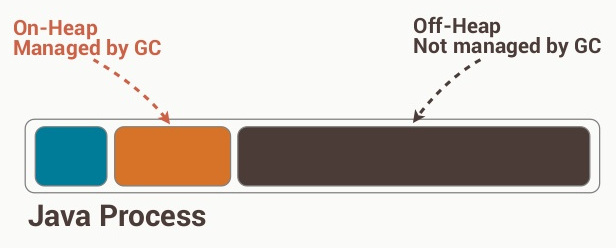
Java GC can only run in JVM heap which is called on-heap memory. However, to control the rubbish collection size of Java GC to realse some pressure of it . we can also open some memory space outside JVM heap in the Operating system level. This part of memory is called off-heap memory.


How do we manipulate off-heap memory ?

Normally there exits 3 opensource library for us to use , Chronicle Queue、Chronicle Map and Thread Affinity . These 3 can help us manipulate off-heap memory flexibly.

When do we use off-heap memory ?

  1. When Some Java NIO related APIs are called,  we may use off-heap memory indirectly. Operating system's kernel(eg: linux kernel) will directly write data into the off-heap memory rather than do like normal API caching one copy of data in the linux kernel then copying another one into the application when the application want to read. 
  2. When Java JVM management can't fullfil the project's requirement, we need to use the off-heap memory and manage it flexbily ourselves. 

For example : 


One incoming connection is to ask for 2M to create 2000 small Objects in Java and to release this 2M memory immediatly  when connection is finished/broken. For Java GC, this is a extra burden to manage those extra 2000 objects  and GC doesn't know those 2000 Objects' memory can be released immediatly after being used (Connection is finsihed). But we , programmers, know this logic and we know better what will happen in the system memory and JVM, so in that case , we can write code ourselves to manage the memory in the most efficient way.

How do we create a off-heap memory space?

One of those methods is to use DirectBuffer :


ByteBuffer.allocateDirect(size)

Another way is to use JNI to write a C/C++ extension in JAVA, in the extension, we don't create memory space in JVM.

But normally, I don't think people may need write in this very backend way.
If you are focus on normal business logic , I think chronicleMap will fullfil your requirement.
If you are writing some frameworks in Java related to NIO, the first method may apply(eg: Netty , ActiveMQ).
But if you don't limit your language in Java, write a C extension to control the whole system. This is the best solution, isn't it.

Sunday, September 10, 2017

Introductory python code of bayes


This article is a introduction of how to use bayes in python. naive bayes is a probability model/formula which is used under lots of constraints . In reality , I seldom use it as normally data from industrial environment can't fit the bayes' constraints which is "Law of large numbers" and max-lilkelihood normally is build under lots of assumptions which make the model inaccurate.  In this article ,I won't derive the formula as typing math formulas in computer is a terrible work for me. :)

I will use the digit recognition data set from kaggle to demostrate how the basic flow works .


Import libs & datas 


%%time

import numpy as np
import pandas as pd
from sklearn.lda import LDA
from sklearn import datasets 
from sklearn import metrics
from sklearn.model_selection import KFold
from sklearn.naive_bayes import GaussianNB  # import into bayes lib
dataset = pd.read_csv("train.csv")
target = dataset[[0]].values.ravel()
train = dataset.iloc[:,1:].values
test = pd.read_csv("test.csv").values

x_finaltest = test  # test data

kf = KFold(n_splits = 10)

Train & predict in 10 Fold CrossValidation 

total_score1 = []
gnb = GaussianNB()
for train_index ,test_index in kf.split(train):
    x_train = train[train_index]
    y_train = target[train_index]
    x_test  = train[test_index]
    y_test  = target[test_index]
        
    gnb.fit(x_train, y_train)  # train the model
     
    y_predict1 = gnb.predict(x_test)  # predict 

    total_score1.append(metrics.accuracy_score(y_predict1,y_test)) # compare and score

# print average score
print(np.mean(total_score1))

y_pred1 = gnb.predict(x_finaltest) # predict

# save into file
np.savetxt('bayes.csv', np.c_[range(1,len(x_finaltest)+1),y_pred1], delimiter=',', header = 'ImageId,Label', comments = '', fmt='%d')

0.556166666667
Wall time: 4min 32s


Monday, September 4, 2017

Bit & BitSet


Bit and BitSet are very commonly used in profiling your java code. Also, In interviews, your interviwers may also ask some questions about it . Raw bit manipulations are mostly tested in job interviews which are hard for most of us but BitSet are mostly used in real projects which is easy to use.


Basics

And(&)
0 & 0= 0
1 & 0 = 0
0 & 1= 0
1 & 1 =1
Or (|)
0 | 0 = 0
1 | 0 = 1
0 | 1 = 1
1 | 1 = 1
Xor (^)
0 | 0 = 0
1 | 0 = 1
0 | 1 = 1
1 | 1 = 0

x << y means x shifted by y bits to the left. for example :
               00011001 << 2  = 00000110
               00011001 << 4  = 10010000
x >> y means x shifted y bits to the right , for example :
               00011001 >> 2 = 00000110
               00011001 >> 4 = 00000001

Interview Questions

You have two 32-bit numbers, N and M and 2 bit positions, i and j .write a method to set all bits  between i and j in N  equal to M(eg: M becomes a subString of N located at i and starting at j)
Example : Input : 10000000000 , M = 10101, i = 2, j = 6
                   Output : N = 10001010100


public static int updateBits(int n , int m, int i, int j) {
  int max = ~0; // All 1's
  
  // 1's through position j, then 0's
  int left = max - ((1 << j) - 1);
  
  // 1's after position i
  int right = ((1 << i) - 1);
  
  // 1's , with 0's between i and j 
  int mask = left | right;
  
  // clear i through j, then put m in there
  return (n & mask) | (m << i);
  
 }

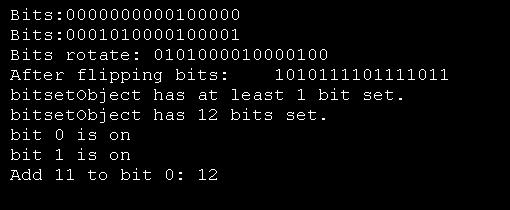
Bitset : BitSet is introduced in Java 1.1 and it only has a few of methods which are commonly used. But These methods are very helpful in tuning our application expecially in Comparison & Filtering.

Previously, if the criteria in our if-statement is comparison, for example

List<Bid> candidateBid = new ArrayList<>();
PotentialBid potentialBid = new PotentialBid();
candidateBid.stream()
	.filter(x -> x.getAutionType() == potentialBid.getAutionType()) // int
	.filter(x -> x.getCountryCode() == potentialBid.getCountryCode()); // String

Improvement makes matching faster :


BitSet candidateBid = new BitSet(); // imagine it has datas
candidateBid.and(autionTypeMatch.getCandidates(bid)); // get intersection set == filter
candidateBid.and(countryMatcher.getCandidates(bid)); // get intersection set == filter

Bitset can hold 2^31 -1 elements , in other word , it can hold huge amount of data.
So , There are still other applications of BitSet , like save a billion data....

Add Loading Spinner for web request.

when web page is busily loading. normally we need to add a spinner for the user to kill their waiting impatience. Here, 2 steps we need to d...